We value your privacy With your consent, we use Google Analytics to count visits and downloads. Declining does not limit access to any content. Learn more in our Privacy Policy
Residents, associations, public administration and technical staff discussed how to collect people’s experiences, understand accessibility and support decisions. The three focus groups explored different tools: Access Together, the decision support system (DSS) and Access Lab.
The experiences of people living in Municipio XII.
How to collect people’s experiences, keep contributions simple and provide useful feedback.
When13 January 2026
18:00–20:30
WhereYouth Centre · Piazza Pietro Merolli
The discussion13 people · residents and associations
The discussion
After the initial questionnaire and project presentation, the discussion started from familiar tools such as Waze, Moovit and Google Maps. Future app features were presented in general terms to leave room for suggestions.
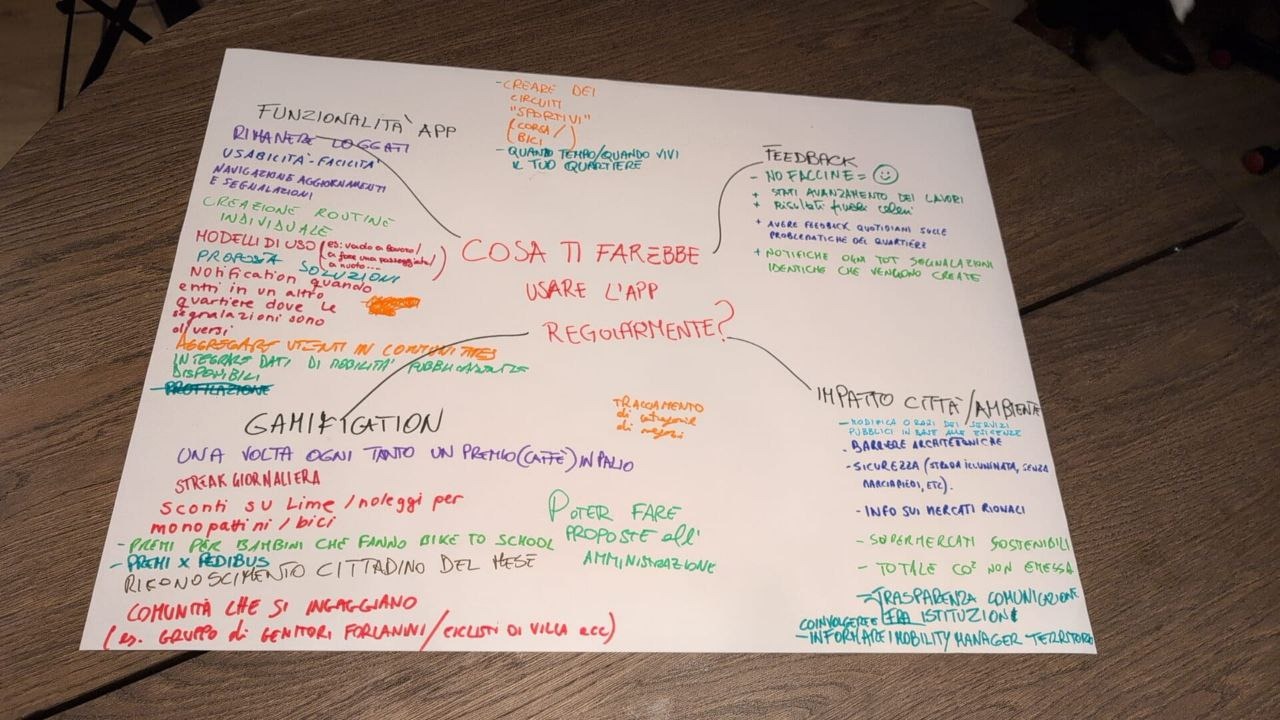
Four questions guided the discussion: which experiences to collect; what information to give back and when; how to keep the tool simple; and what builds trust and transparency. A collaborative map brought together the final ideas.
Simple, useful contributions
Participants asked for short questions, little time commitment and straightforward steps, including a quick initial report that could be completed later. They called for trials with real users and ongoing discussion during development.
Experiences are not limited to journeys with a destination: walks, sporting activities and trips without a specific purpose were mentioned. Safety, comfort and accessibility can matter more than the shortest route.
Feedback and trust
Willingness to contribute data and local knowledge came with a request to see follow-up: report status, progress, outcomes and history. Structured, action-oriented contributions were preferred to general forums or chats.
Ways of supporting proposals were discussed, alongside the risk of reducing complex issues to yes or no. Accessibility for people with reduced mobility was described as a need to protect, not just a preference to vote on. Willingness to provide profile information was linked to a clear, useful purpose.
The ideas map
The collaborative ideas map
Focus group 2 · Decision support · completed
The tools for decision-makers.
How to organise existing information and make it useful for departments’ work and decision-making.
When25 February 2026
11:00–13:45
WhereMunicipio XII Council Chamber · Via Fabiola 14
The discussion11 people · public administration, technical staff and partners
The discussion
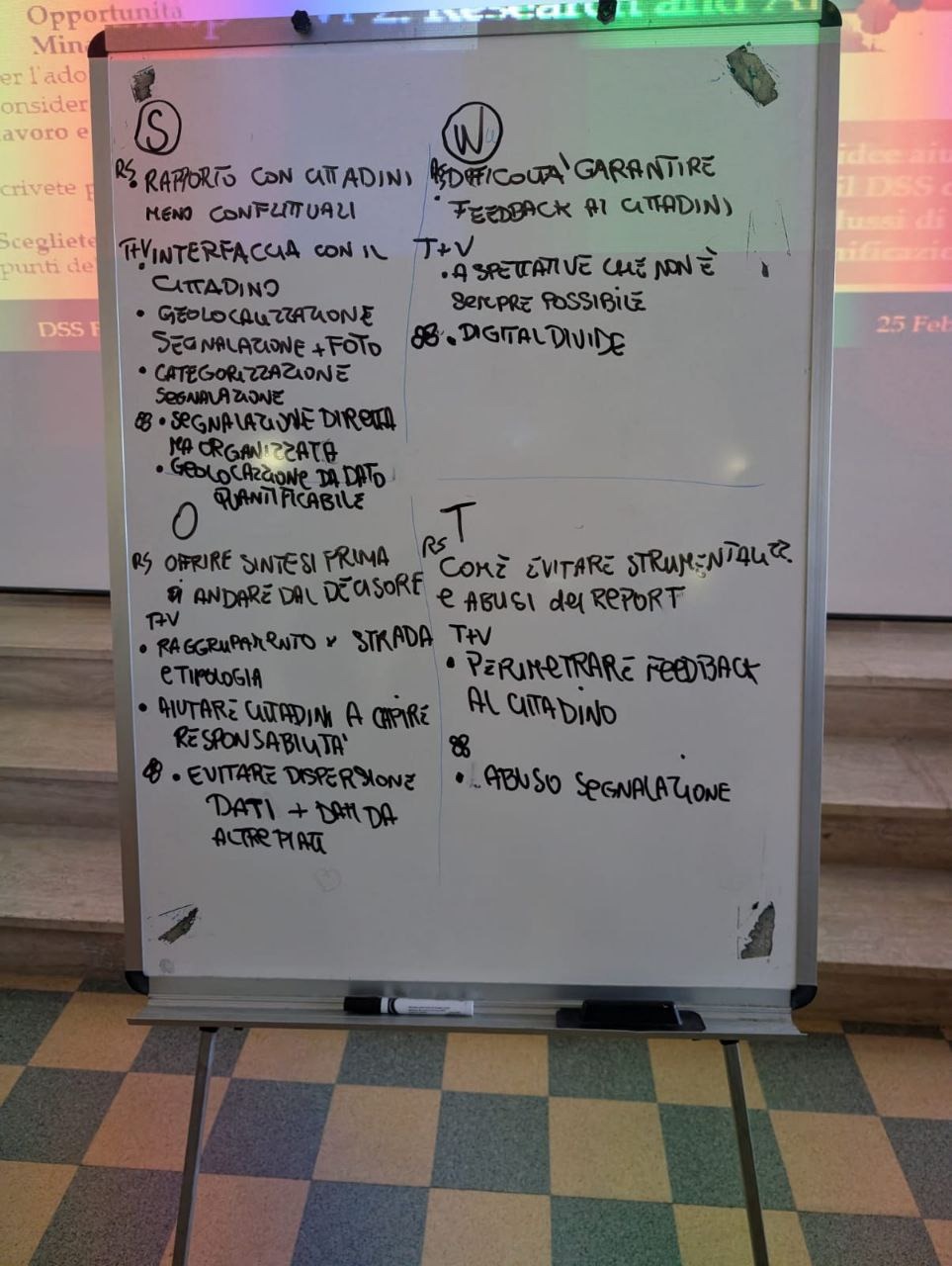
The morning focused on the decision support system (DSS) and its integration into administrative processes. After the presentation, the discussion involved public administration, the mobility agency, local police and municipal departments. A final exercise collected strengths, weaknesses, opportunities and threats.
From reports to evidence
Departments already receive contributions through email, certified email, formal records, contact centres, platforms, phone calls and direct contact. Fragmentation creates work and makes it difficult to track information.
The expected value of the DSS is to organise, filter and summarise contributions: identify recurring problems and differences between areas, connecting objective data and perceptions. There was no call simply to create another reporting channel.
The conditions shaping decisions
Decisions depend on more than requests: safety, responsibilities, funding rules and budgets all matter. People’s experiences remain relevant to understanding everyday conditions and how interventions are experienced.
Protecting more vulnerable people, maintaining dialogue with residents and interoperability with existing platforms were highlighted. Transparency should cover both data and the limits of possible feedback.
Findings from the discussion
The discussion highlighted the need to connect information already collected, make it understandable and use it to identify recurring problems and priorities. The tools will need to consider departmental responsibilities and available resources.
The strengths and challenges board
Focus group 3 · Access Lab · completed
Accessibility for different people.
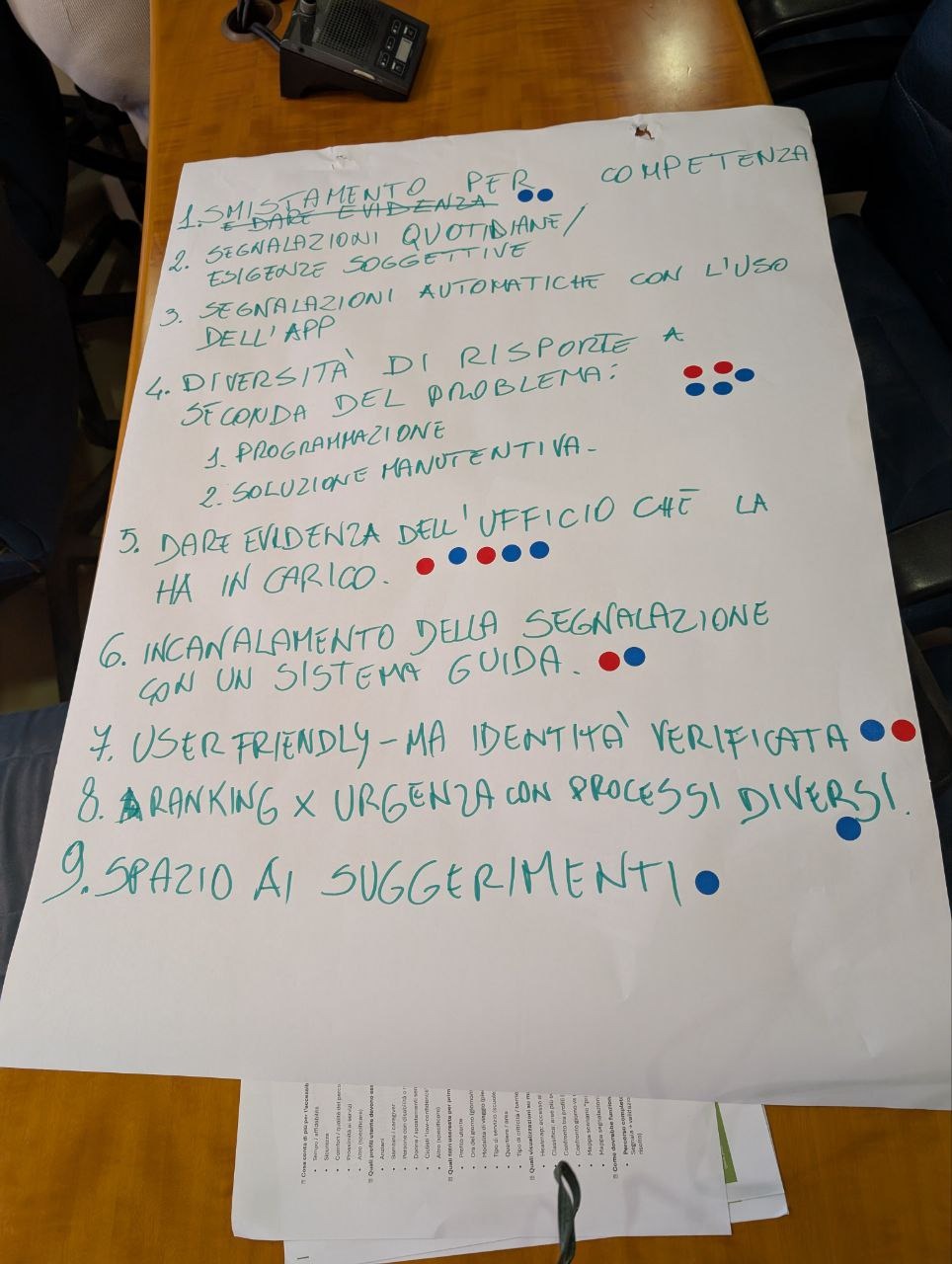
In the third focus group, dedicated to Access Lab, we voted on accessibility conditions, user profiles and filters to consider in the analyses, as well as feedback on contributions.
When25 February 2026
14:30–17:00
WhereMunicipio XII Council Chamber · Via Fabiola 14
The discussion12 people · residents, associations and institutional representatives
The discussion
After the Access Lab presentation, participants discussed and voted on three questions: what matters for accessibility, which profiles and filters to represent in the analyses, and how to provide feedback on contributions.
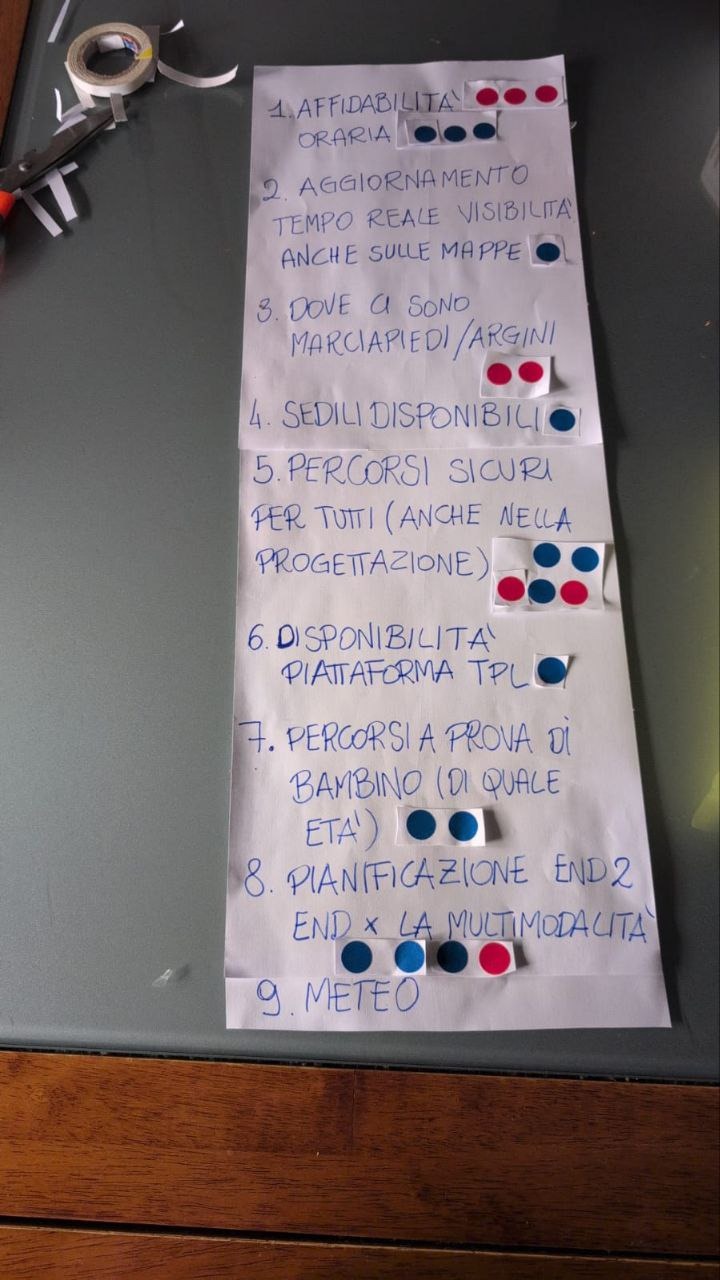
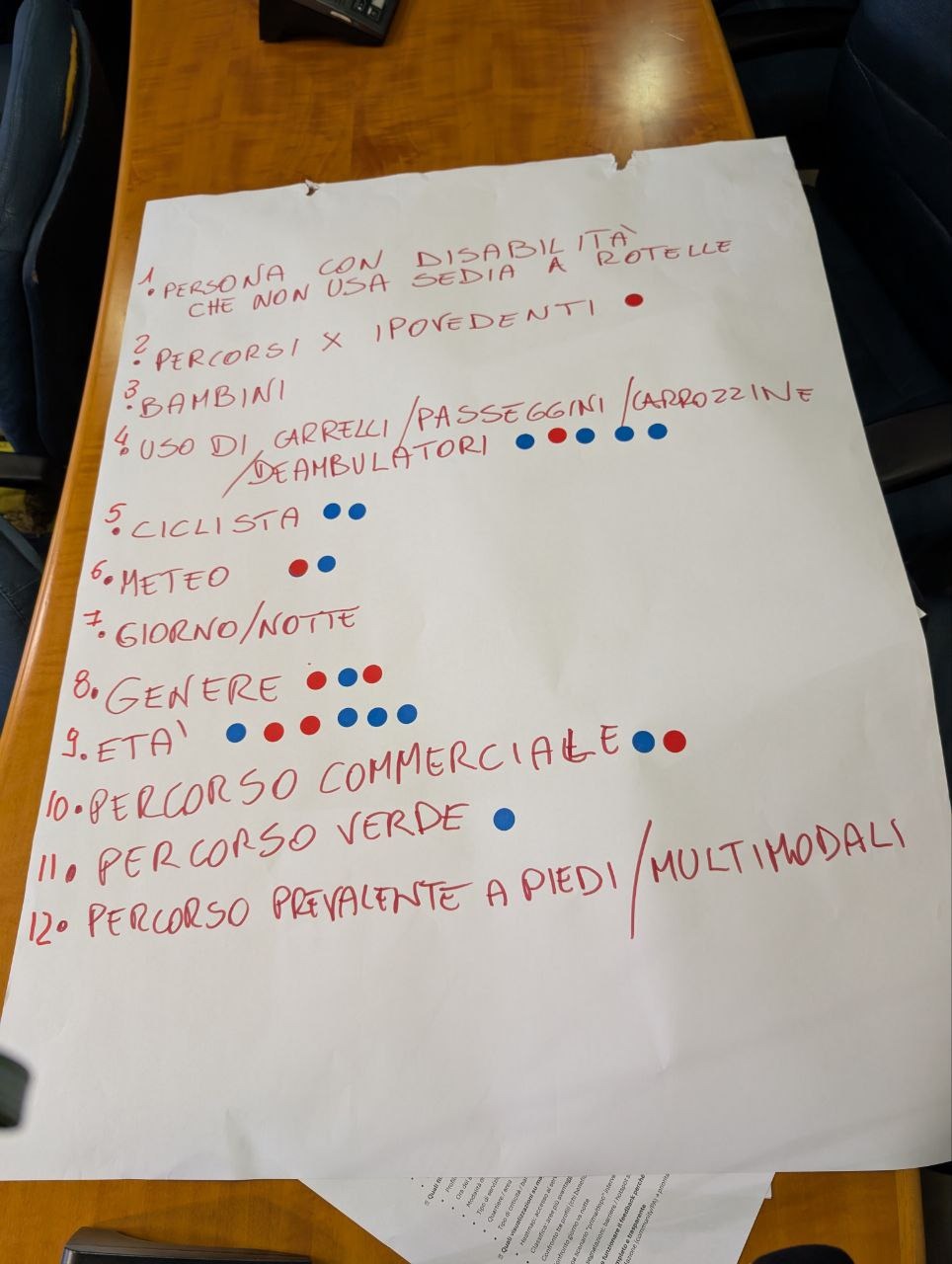
With Dotmocracy, people indicate priorities by placing dot stickers on proposals. Votes from the two groups are shown separately.
Reliable and safe journeys
Reliable timetables, safe routes and continuity between different modes were among the priorities raised. Being able to move around matters beyond proximity alone.
What matters for accessibility?Focus group 3 · Access Lab · question 1
Blue · ResidentsRed · Public administration and technical staff
What matters for accessibility?
6
Timetable reliability
Residents: 3Public administration and technical staff: 3Total: 6 votes
1
Real-time updates, including on maps
Residents: 1Public administration and technical staff: 0Total: 1 vote
2
Pavements or path edges
Residents: 0Public administration and technical staff: 2Total: 2 votes
1
Places to sit
Residents: 1Public administration and technical staff: 0Total: 1 vote
5
Safe routes for everyone, including during planning
Residents: 3Public administration and technical staff: 2Total: 5 votes
1
Availability of a public transport platform
Residents: 1Public administration and technical staff: 0Total: 1 vote
2
Age-appropriate routes for children
Residents: 2Public administration and technical staff: 0Total: 2 votes
4
Multimodal planning from start to finish
Residents: 3Public administration and technical staff: 1Total: 4 votes
0
Weather conditions
Residents: 0Public administration and technical staff: 0Total: 0 votes
The accessibility conditions board
User profiles and analysis filters
The second vote in the third focus group concerns user profiles and Access Lab filters. Age, gender, pushchairs and mobility aids were among the most voted aspects: input for representing practical conditions in the analyses.
Which profiles and filters should Access Lab include?Focus group 3 · Access Lab · question 2
Blue · ResidentsRed · Public administration and technical staff
Which profiles and filters should Access Lab include?
0
Disability without wheelchair use
Residents: 0Public administration and technical staff: 0Total: 0 votes
1
Routes for people with visual impairments
Residents: 0Public administration and technical staff: 1Total: 1 vote
0
Children
Residents: 0Public administration and technical staff: 0Total: 0 votes
5
Shopping trolleys, pushchairs, wheelchairs and walking frames
Residents: 4Public administration and technical staff: 1Total: 5 votes
2
Cycling
Residents: 2Public administration and technical staff: 0Total: 2 votes
2
Weather conditions
Residents: 1Public administration and technical staff: 1Total: 2 votes
0
Day and night
Residents: 0Public administration and technical staff: 0Total: 0 votes
3
Gender
Residents: 1Public administration and technical staff: 2Total: 3 votes
6
Age
Residents: 4Public administration and technical staff: 2Total: 6 votes
2
Shopping route
Residents: 1Public administration and technical staff: 1Total: 2 votes
1
Route through green spaces
Residents: 1Public administration and technical staff: 0Total: 1 vote
0
Mainly pedestrian or multimodal route
Residents: 0Public administration and technical staff: 0Total: 0 votes
The profiles and filters board
Clear, visible feedback
Participants asked for responses suited to the problem, an identifiable responsible department and clear steps for following reports.
How can meaningful feedback be provided?Focus group 3 · Access Lab · question 3
Blue · ResidentsRed · Public administration and technical staff
How can meaningful feedback be provided?
2
Assignment by responsibility
Residents: 2Public administration and technical staff: 0Total: 2 votes
0
Everyday reports and individual needs
Residents: 0Public administration and technical staff: 0Total: 0 votes
0
Automatic reports through app use
Residents: 0Public administration and technical staff: 0Total: 0 votes
5
Different responses: planning and maintenance
Residents: 3Public administration and technical staff: 2Total: 5 votes
5
Visibility of the responsible department
Residents: 3Public administration and technical staff: 2Total: 5 votes
2
Guided reporting steps
Residents: 1Public administration and technical staff: 1Total: 2 votes
2
Ease of use and verified identity
Residents: 1Public administration and technical staff: 1Total: 2 votes
1
Urgency and different processes
Residents: 1Public administration and technical staff: 0Total: 1 vote
1
Room for suggestions
Residents: 1Public administration and technical staff: 0Total: 1 vote
The feedback on contributions board
After the meetings
What has changed and the next steps.
You asked for simple tools, clear information about data and meaningful feedback. Here is what we have decided, what we are developing, what we propose and what will come later.
Decided
What has been chosen
No forums or chats: people contribute by answering structured questions.
Contributions do not change the official map: they remain separate evidence and are verified before being used in the analyses.
Contributing from a browser requires no name or email.
In development
What we are working on
Shorter assessments: a few essential questions, the rest optional.
Trials in small groups with the team, from 14 November at Largo Ravizza: we will note difficulties and suggestions.
Clear information about which data we collect and why, available before taking part.
Age, mobility aids and prams: we already collect them and will use them in the calculations once the data make this reliable.
Improvement proposals as a separate contribution, without a yes or no vote.
Seeing how many contributions have arrived for each area.
Naming the responsible body and its reporting channel.
Later
What is not here yet
Knowing where your report stands. For now the tools do not send reports to public bodies, so we cannot promise any action.
Seeing what happens to contributions (assessments, priorities, decisions). This will come with the tools for public offices, in the next phase of the project.
Analyses of buses, metro and journeys with more than one travel mode. In this phase we study people on foot; the app still records journeys in every travel mode.